Sunday, 8 November 2026
The word of the cross : A miracle
Ps Shinoj Joseph 1 Corinthians 1:18
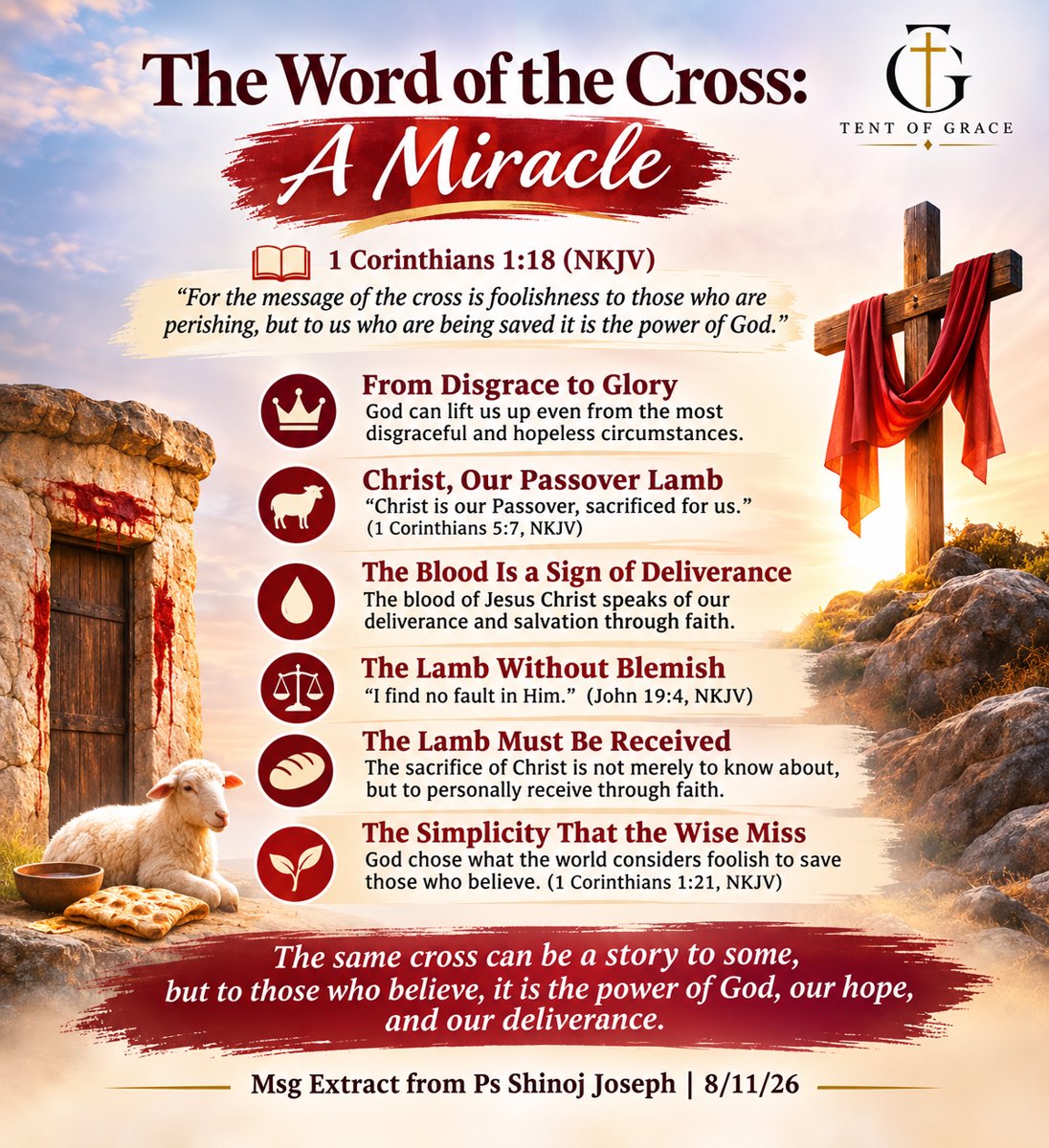
"...the message of the cross is foolishness to those who are perishing..."
— 1 Corinthians 1:18 (NKJV)
Paul continues that, to those who are being saved, this same message is the power of God. The same cross can be heard in two very different ways. To some, it is simply a story, an event from long ago. To those who believe, it is hope, and a miracle. What makes the difference is not the cross itself, but how we receive it in faith.
In this reflection, one question to ask - what the message of the cross actually is, how something so disgraceful could become the power of God, and why its very simplicity is the reason so many miss it.
Paul in a Land of Knowledge
To appreciate this message, it helps to remember where Paul preached it. Greece was renowned as a land of knowledge, a culture that had given the world much of its philosophy and learning. Into this intellectually confident society, Paul arrived with the message of a man crucified on a cross. By the standards of his audience, it was hardly an impressive message.
Yet Paul came with a clear resolve. Although he had been trained under Gamaliel, one of the most respected teachers of his day, he would not speak as the learned of Greece spoke. He chose to bring no human wisdom, only the message of the cross.
What Is the Message of the Cross?
Crucifixion was a Roman form of capital punishment, reserved for slaves, thieves and political criminals. Roman citizens were exempt from it because it was considered too shameful. It was, quite simply, the most disgraceful way to die.
This is the message Paul carried into the company of the "wise." And it carries a truth worth holding on to:
God can lift us up from the most disgraceful circumstances, even in the worst of situations.
But what good could possibly come from such a shameful death? By human reckoning, this is an event that should have been forgotten. To the worldly wise, it was merely a man executed for some wrongdoing. To those who are being saved, however, it is far more than a death.
How Does the Cross Become Power?
To understand this, we need to understand why it happened. Scripture gives Jesus another name: the Passover Lamb.
"For indeed Christ, our Passover, was sacrificed for us."
— 1 Corinthians 5:7 (NKJV)
The Passover in Egypt
To understand this name, we go back to Exodus 12. The Israelites in Egypt cried out for deliverance. Many miracles took place, yet they remained in bondage. The final means of their freedom was the Passover lamb.
God instructed each household to choose a lamb without blemish and keep it apart until the fourteenth day of the month, so that it could be confirmed as perfect. After the lamb was slain, its blood was to be marked on the doorposts of the house.
We can imagine the Egyptians looking on and thinking, "If you want to save yourselves, take up the sword." But the Israelites trusted that the blood was the only way. To the world, it looked foolish. To them, it was their only hope.
Christ, the Lamb Without Blemish
Jesus, too, was taken into custody and accused of every kind of wrong. Had He died without those accusations being examined, no one could have said He was without blemish. But Pilate, the judge, examined the charges and declared:
"I find no fault in Him."
— John 19:4 (NKJV)
The Lamb of God was publicly confirmed to be spotless.
First: The Blood Is a Sign
In Egypt, the blood on the door was the sign that kept the destroyer away; he would pass over that house. The destroyer did not care about titles, status or achievement. The only thing that mattered was whether the house bore the mark of the innocent lamb's blood.
So it is for us. The blood is a sign of the cross, and it is deliverance for all who believe.
Second: The Lamb Must Be Received
The Israelites were not only to mark their doors with the blood; they were also to eat the flesh of the lamb. Jesus took up this image when He spoke of Himself as the true bread from heaven (John 6). Manna sustained Israel only for a day, but He is the bread that does not perish, the bread that leads to eternal life.
The grace we experience, then, is not a shadow of the Old Testament. It is the reality of the sacrifice God Himself has provided.
The Simplicity That the Wise Miss
This truth cannot be reached through worldly knowledge alone. Paul observes that the world, for all its wisdom, did not come to know God; instead,
"...it pleased God through the foolishness of the message preached..."
— 1 Corinthians 1:21 (NKJV)
to save those who believe. The greatest message of salvation came wrapped in what looks like foolishness. To save a complicated humanity, God chose the simplest of messages: the cross. And perhaps that is precisely why so many fail to see it. It is too simple for those who expect something more sophisticated (see also 1 Corinthians 2:9).
Closing Reflection
To enter into this salvation, we do not need our knowledge, our titles or our achievements. We need only to believe.
The cross will always be heard in two ways. For some, it will remain a story. For those who believe, it is the power of God and a hope that delivers.
Which is it for you?
Scripture taken from the New King James Version®. Copyright © 1982 by Thomas Nelson. Used by permission. All rights reserved.